
GUEST REQUEST
“Find me a romantic happy hour spot for Friday night with specials on food in Marina area for me and my date ”
Strategic prototype for AI-powered discovery
My role: Leading product design strategy and user research.
Problem: The existing Toast restaurant takeout marketplace experience was outdated and made it difficult for guests to discover restaurants. It lead to only 10% of homepage visitors converting to placing an order. We also had two marketplace websites—one for takeout and one for dine-in reservations. This fragmented the guest experience while doubling our efforts and affecting search engine visibility.
Solution: We built a combined web marketplace for discovering all Toast restaurants, starting with familiar search and filtering patterns that worked. We then explored an AI-powered conversational experience that understood nuanced requests and identified the best matches for guests, helping us differentiate from competitors.
Status: MVP experience is 100% released, AI prototype validated with users and used to inform the future roadmap.
MVP Outcomes:
62K+ site views
+22% takeout conversion
+24% reservation conversion
THE PROBLEM
I conducted 10 moderated interviews to understand how guests search restaurants and where current discovery process falls short:
Basic search requests worked well, but searches like “pet-friendly restaurant” often required searching across multiple sources.
Ratings, cuisine, and price helped narrow options, but guests needed more details to understand whether a restaurant was the right fit.
They preferred fewer, more relevant recommendations with clear explanations for why each option matched their needs.

I’ve used ChatGPT (and my best judgment) to help me write research script, synthesize all research findings, and write insights to share with the team.
"If I'm looking for somewhere to take my son to eat, how hard is it to show me if the restaurant has a playground? It's really tricky to find places to go out to eat that have playgrounds for children." Guest research participant
Roadmap prioritization
Research led to the hypothesis that understanding guests’ nuanced needs and surfacing highly relevant results could differentiate our experience from competitors. With limited engineering capacity and restaurant data still maturing, we couldn’t build the full discovery vision at once. I worked with product and engineering to sequence the roadmap around two goals: delivering guest value early while building the foundations for more advanced discovery.
While the data foundation was still developing, we've decided to launch a focused combined marketplace MVP to deliver value and learn from real guest behavior.
Research validated restaurant pages, map-based discovery, and reviews as foundational. I used Claude Code to prototype and test these experiences qickly before committing additional engineering resources.
As the underlying data and infrastructure matured, I developed and tested a vision for AI-powered restaurant discovery that could better understand guests’ needs and surface highly relevant recommendations.
MVP: Design and iteration
For the first phase, I've designed a desktop and mobile marketplace experience that combined two existing separate marketplaces allowing guests to search and filter across all Toast restaurants.
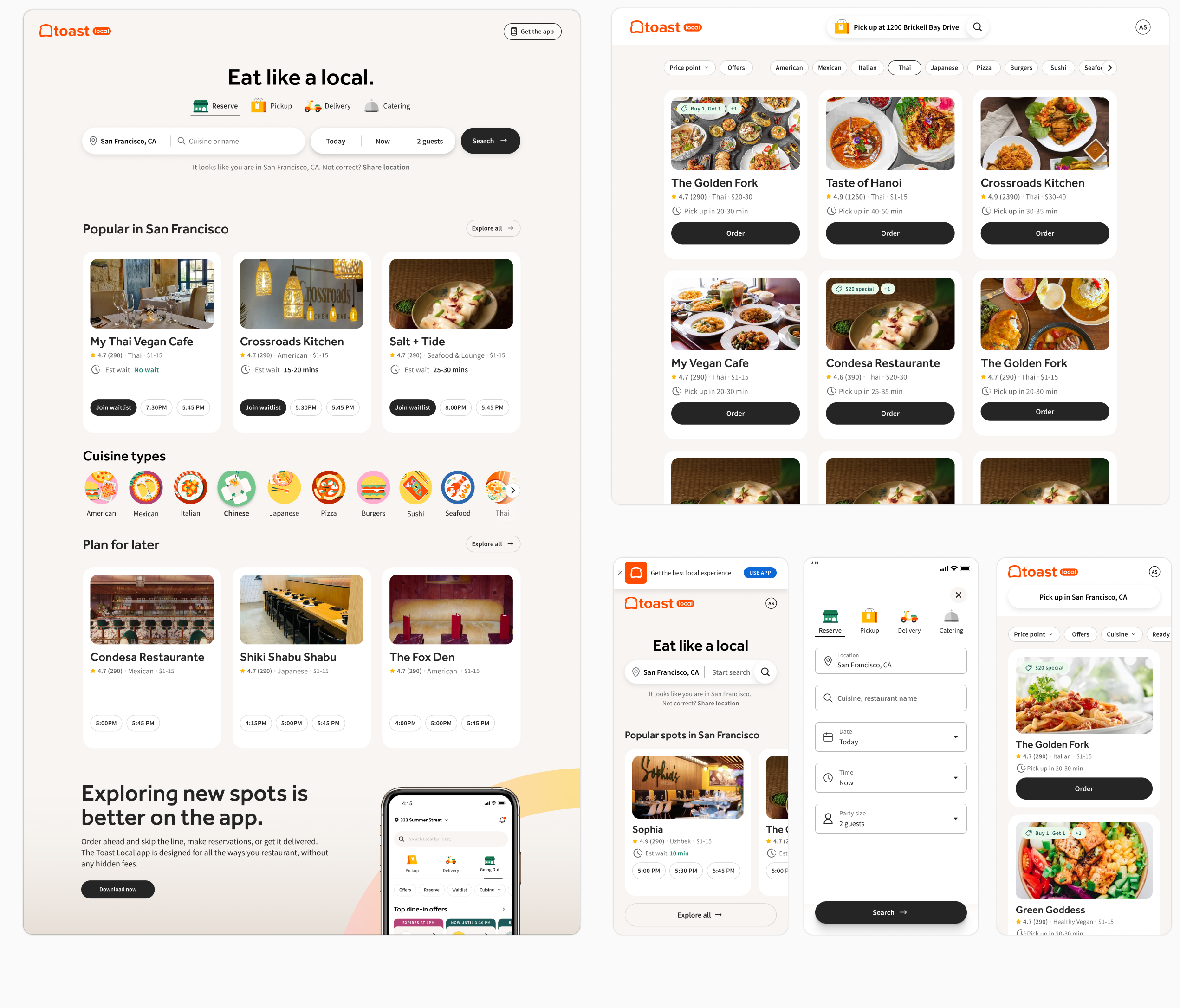
After creating a combined market place experience, we've launched the phase one of the marketplace, so we can start learning and making impact quickly.
MVP Outcomes:
62K+ site views
+22% takeout conversion
+24% reservation conversion

Fast-tracking phase two
One of the main challenges on this project was having very limited engineering resources and a lot of things we needed to do. We often had to prioritize between improving SEO and user experience.
I used Claude Code to build working prototypes of the restaurant page and map-view discovery directly in code. This allowed us to get feedback from users with only a few hours of engineering support—turning what previously took months into days.
“I wish that I could just have an app know my preferences first off or me be able to input my situation and my specifications on what I'm looking for and have it recognize those things.” Research participant
The MVP marketplace improved how guests found restaurants, but our research revealed a deeper need: guests weren't simply searching—they were making decisions shaped by context, preferences, constraints, and subjective needs.
For the next phase, I designed a conversational AI experience that let guests express those needs naturally, rather than translating them into keywords and filters.
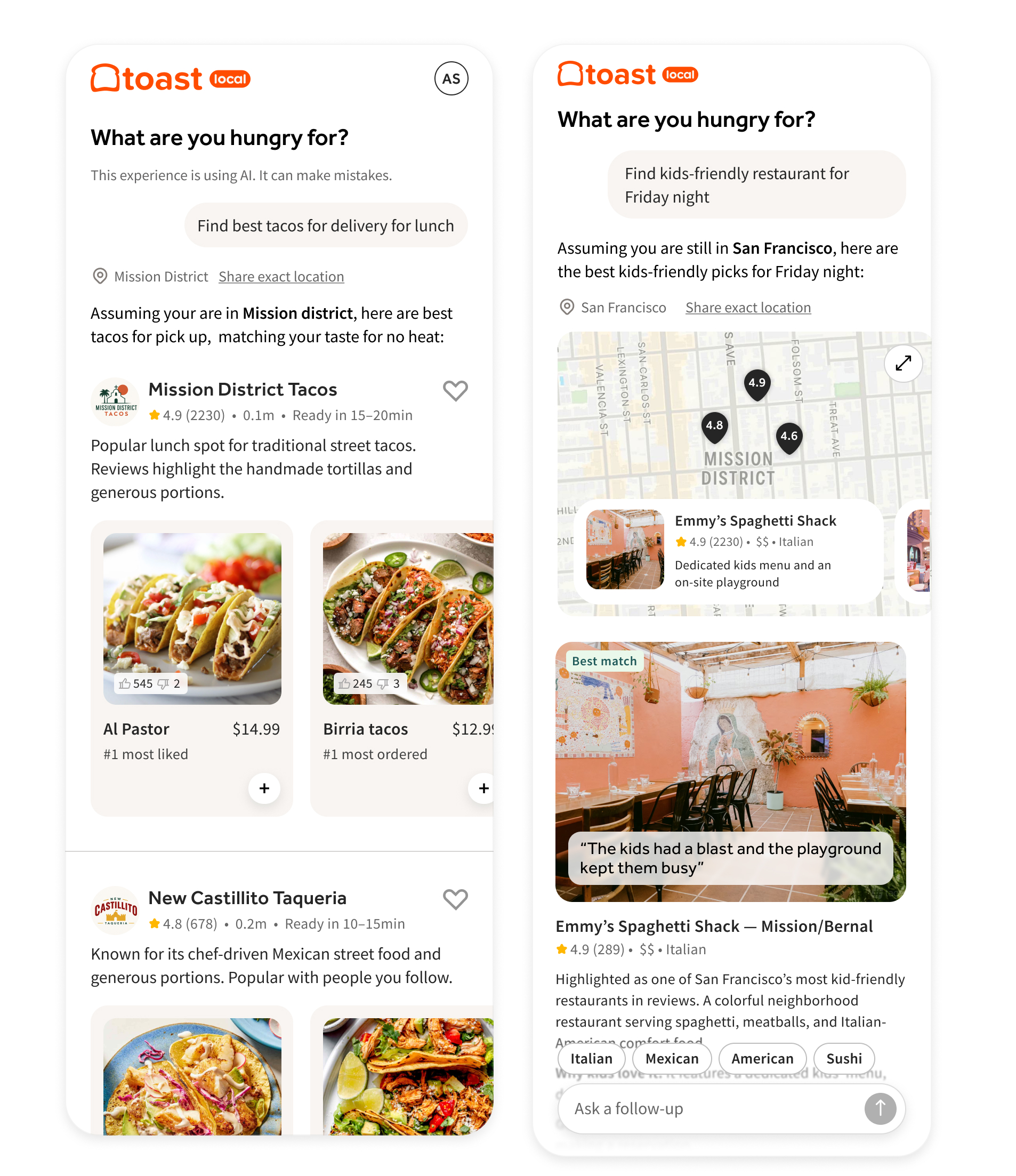
Conversational discovery required more than matching keywords. I defined how the experience could interpret both explicit constraints and subjective intent, then evaluate potential matches against available evidence—including signals unique to Toast, like menu-item feedback and guest ordering history.
Rather than asking guests to compare dozens of results themselves, the AI could surface a small set of relevant options and explain the evidence behind each recommendation.
“Find me a romantic happy hour spot for Friday night with specials on food in Marina area for me and my date ”
Apply hard constraints to identify viable candidates.
Evaluate how well each candidate satisfies the guest's needs using available evidence.
Surface 3 recommendations + reasons
Surface useful context that user is helpful to know (like parking or business information)
THE PROCEED PATH
Once the assistant has enough signal, it should act — not ask another question. Recommendations are the default path; the system only stops to clarify when missing information would significantly change the outcome.
OTHER PATHS
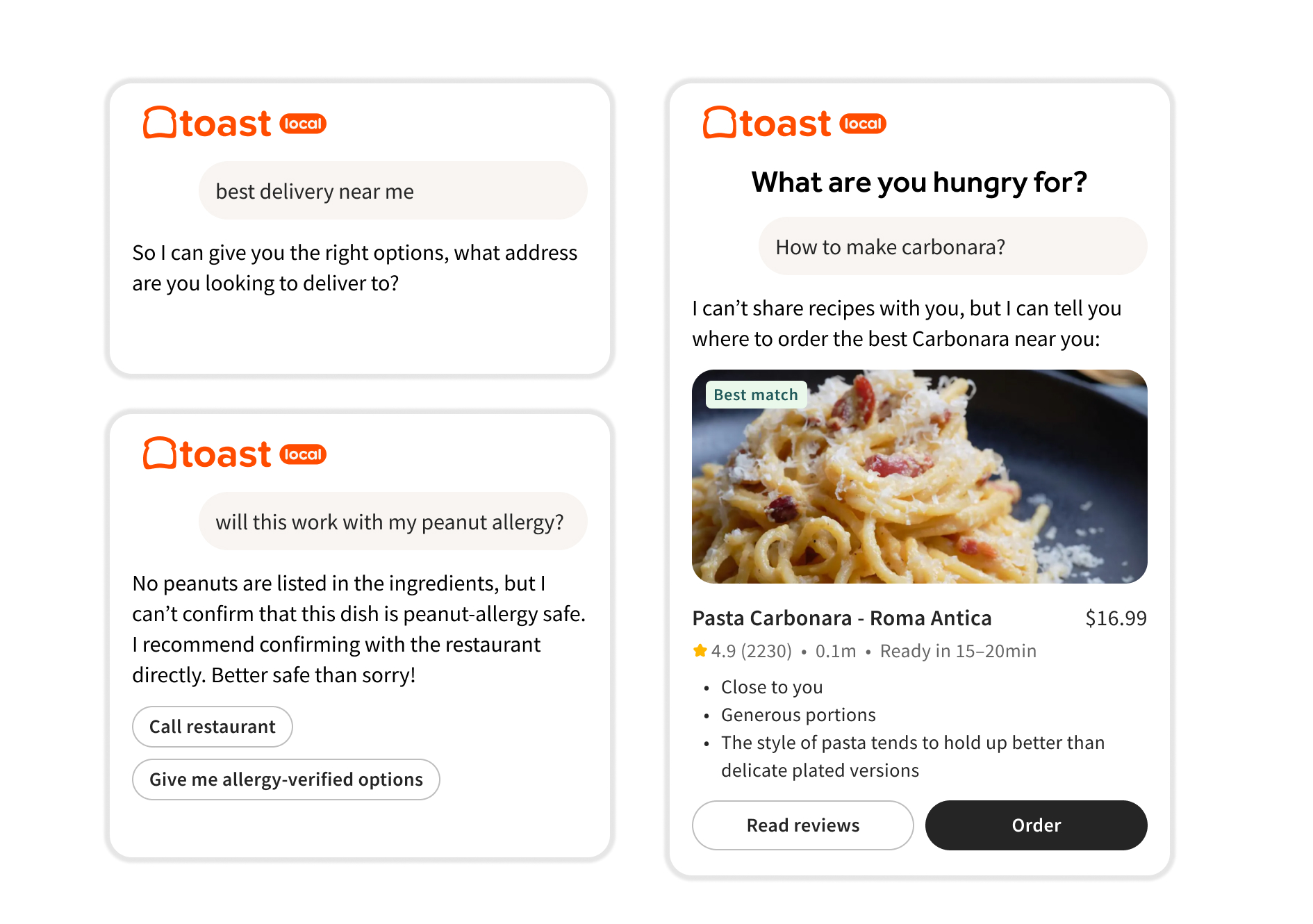
I defined guardrails around three moments when the system needs additional judgment:
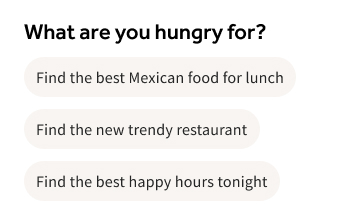
A conversational search field can imply “ask anything.” I used instructional copy and example requests to show guests what the experience was designed to handle and help them get started. Over time, suggestions could be personalized using known guest preferences.
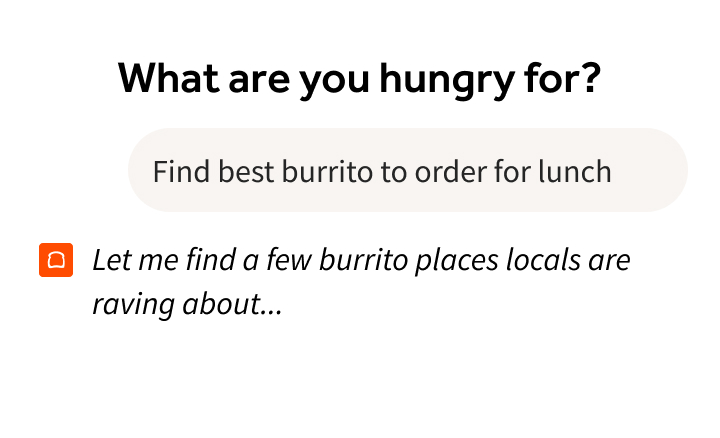
As AI searched for right matches, we used progress narration to build trust. The experience reflects the intent back to the user to show that it understood the request, giving ability to correct if needed. Then it shows the information that AI is checking to help build credibility without exposing complex model reasoning.
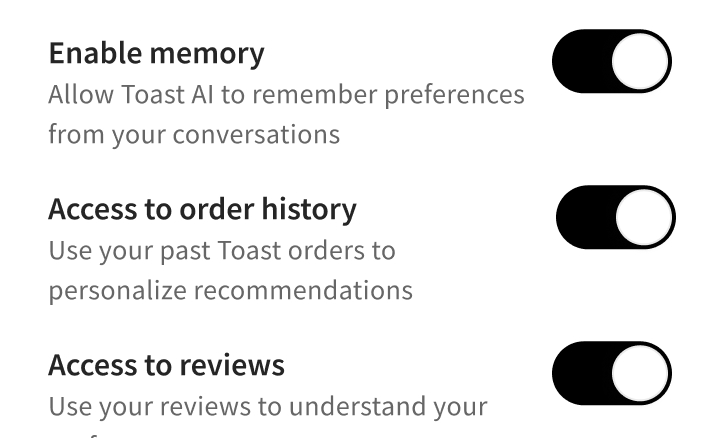
We gave guests full cotrol over what information does the AI have access to and what it remembers from searches. They see what AI remembers about them, edit, and delete memory information.
The prototypes helped align internally around a shared direction and shape the roadmap for AI-powered discovery. The experience had not yet been built.
My biggest learning was that as we shifted from traditional deterministic experiences to more AI-driven, probabilistic ones, the way we designed had to change as well. The success of the experience depended not only on what users saw, but on the quality of the data and logic powering the system behind it.
Design shifted from defining every interaction in front of the user to shaping the decisions happening behind the scenes. A great AI experience wasn’t just about delivering relevant results — it was about building trust by helping users understand why something was recommended and what influenced the outcome.